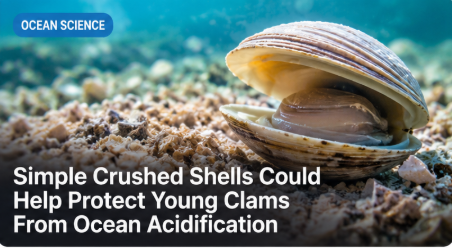
A simple material found along coastlines could offer an interesting way to help protect some marine animals from the effects of ocean acidification.
Researchers at the University of California, Davis, have investigated how adding crushed seashells to coastal sediment affects young Pacific littleneck clams.
Their findings suggest that this relatively simple approach can improve local water conditions and support the development of shell-forming marine organisms.
What Did Researchers Discover?
The research team conducted an experiment at the UC Davis Bodega Marine Laboratory.
Scientists mixed crushed shell fragments, commonly known as shell hash, into sediment where young clams were growing.
Over a period of 90 days, researchers monitored water chemistry and the development of the clams under different experimental conditions.
The results showed that sediment containing crushed shells helped reduce acidity in the water surrounding the animals.
Young clams exposed to these conditions also developed larger shells on average compared with those in conditions without the added shell material.
Why Ocean Acidification Is a Growing Concern
Ocean acidification occurs when seawater absorbs carbon dioxide from the atmosphere.
As the chemistry of seawater changes, organisms that depend on calcium carbonate to build shells and skeletons can face greater challenges.
Young clams, oysters and other shell-forming animals may be particularly vulnerable during their early development.
The research also highlights the value of traditional coastal knowledge. Indigenous communities have long used shell materials in coastal environments, and modern scientific research is helping explain some of the biological processes behind these practices.
Although crushed shells are not a solution to global ocean acidification, the findings suggest that local habitat management may help reduce some of its effects.